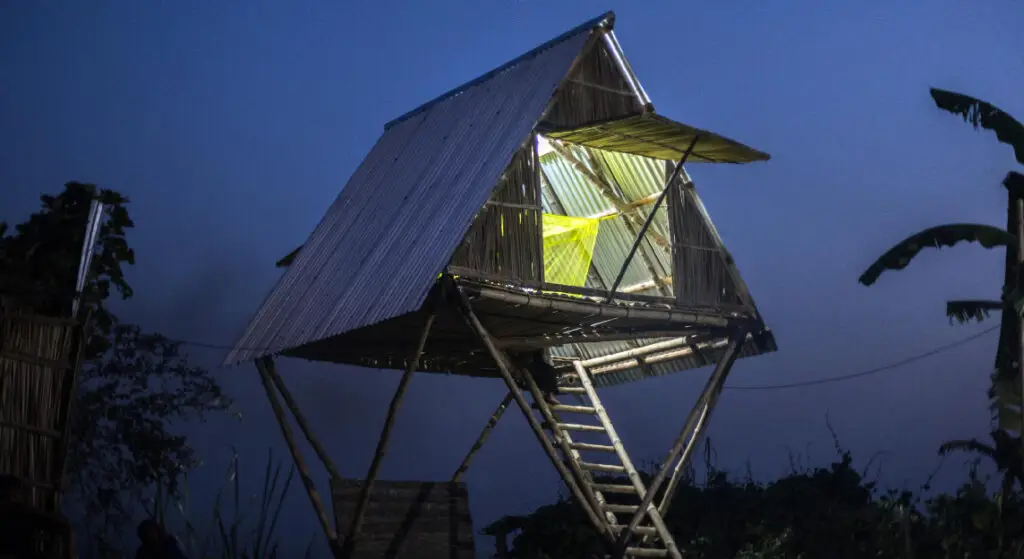
There is a quiet arrogance in the way we often speak about architecture — as permanence, as monument, as something that must resist time. But along the river deltas of Bangladesh, the land itself refuses this idea. It shifts, dissolves, and redraws its own boundaries with every monsoon. In such a place, permanence is not strength — it is fragility.
This is where the work of Marina Tabassum becomes not just relevant, but necessary.
Architecture That Moves With People
Tabassum’s Khudi Bari — literally “tiny house” — is not an object. It is a response.
Lightweight, modular, and elevated, the structure is designed for a reality where millions are displaced annually by flooding. In Bangladesh alone, over 20 million people are at risk of climate-induced displacement, with riverbank erosion swallowing entire communities over time.
The Khudi Bari does something radical in its simplicity:
it accepts movement as a condition of life.
Built primarily from bamboo — a material that is local, renewable, and culturally embedded — the structure can be assembled, dismantled, and relocated with minimal effort. It costs roughly $400–$500, making it accessible to low-income households, and its elevated second level offers a critical refuge during floods.
But beyond function, there is dignity in its design.
It does not look like emergency shelter. It looks like home.
Design as a Social Contract
At Swahili Design Lab, we often ask: who is design really for?
Tabassum answers this with clarity — “Everybody has a right to good architecture.”
This philosophy echoes across her body of work, from the award-winning Bait Ur Rouf Mosque to national landmarks like the Museum of Independence. Her approach strips away excess — no domes, no ornamental gestures — replacing them with something far more powerful: light, proportion, and silence.
In the Bait Ur Rouf Mosque, light itself becomes ornament. Perforations in the structure transform the interior into a shifting constellation — a reminder that architecture is not only about shelter, but about experience.
Climate is the Brief
Too often, climate is treated as a constraint.
In Tabassum’s work, it is the starting point.
Her buildings rely on passive climate design — natural ventilation, shading, and material intelligence — reducing dependence on artificial systems. This is not just sustainable; it is necessary in regions where energy access is limited and temperatures are extreme.
Globally, buildings account for nearly 40% of carbon emissions. The future of architecture cannot be separated from this reality.
What Tabassum demonstrates is that low-tech can be high-impact.
From Bangladesh to the African Coast
If this feels distant, it shouldn’t.
Along the coastlines of Kenya — from Lamu to Mombasa — we are beginning to see similar patterns:
rising sea levels, unpredictable weather, and communities living at the edge of environmental change.
The question is no longer whether we will adapt.
It is how.
At Swahili Design Lab, we see strong parallels between Bangladesh’s floating realities and our own coastal ecosystems. The idea of modular, circular, and locally-rooted design systems is not just inspiring — it is urgent.
What would a “Khudi Bari” for the Swahili coast look like?
What materials would it use?
Who would build it?
These are not design questions alone.
They are economic, cultural, and ecological questions.
The Shift: From Permanent to Possible
Perhaps the most important lesson here is philosophical.
Tabassum challenges the idea that buildings must last 100 years. In a climate-uncertain world, flexibility may be more valuable than durability. Architecture, in this sense, becomes ephemeral — designed to evolve, adapt, and even disappear when needed.
This is not a loss of ambition.
It is a redefinition of it.
A New Design Ethic
We are entering an era where the role of the designer is shifting:
- From creator to listener
- From builder to facilitator
- From permanence to adaptability
The Khudi Bari is small in scale, but immense in implication. It reminds us that the future of design will not be defined by iconic skylines, but by how well we respond to the realities on the ground.
And in that future, the most powerful designs may not be the ones that stand still —
but the ones that know how to move.