Build It Anyway
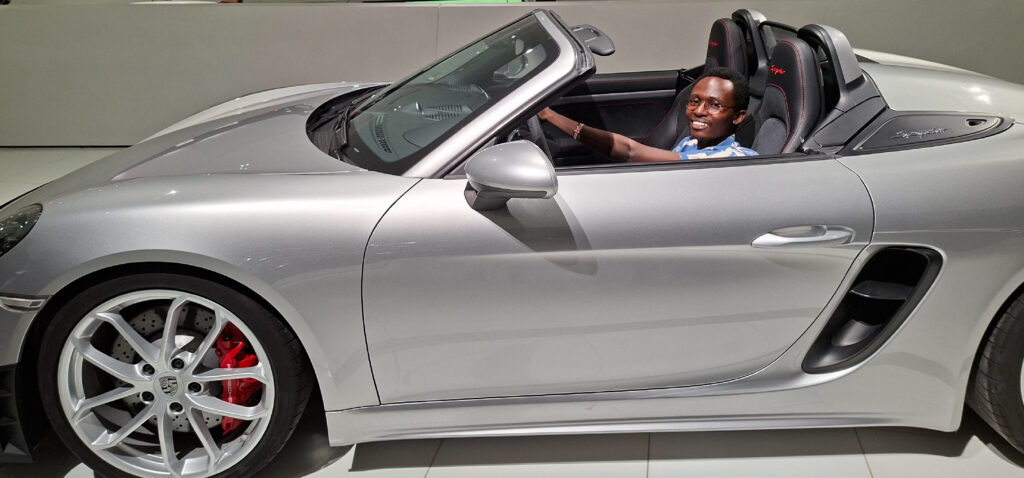
I am Lawrence Kosgei, an MBA student at Kenyatta University and the founder of Swahili Design Lab. For as long as I can remember, I have been drawn to design. Not just the aesthetics of things, but the thinking behind them. Why do things look the way they do? Why do some objects feel inevitable and others feel like compromises? That obsession has taken me down a lot of rabbit holes. One of them led me, recently, to Stuttgart, Germany.
“In the beginning, I looked around and could not find quite the car I dreamed of. So I decided to build it myself.” — Ferry Porsche
I’ve been sitting with that quote since I visited the Porsche Museum last week. It sounds simple. Almost too simple. But I think it contains something important that we keep forgetting.
Most of us, when we can’t find what we’re looking for, stop looking and settle for the closest thing. Ferry Porsche did something different. He decided the gap between what existed and what should exist was not a dead end. It was an invitation.
That’s a subtle but radical shift in how you see the world.
Here’s how I ended up there. After my business in Germany was done, I had exactly one day left. One day, and two museums I genuinely wanted to visit—the Mercedes-Benz Museum and the Porsche Museum, both in Stuttgart, both world-class. I was already negotiating with myself about which one to sacrifice when my friend Vandana settled the debate for me.
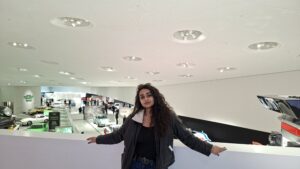
Vandana is from India, and she is, there is no other word for it, obsessed with Porsche. Not just the cars — the story, the design philosophy, the whole thing. She’d been talking about the museum since before we even landed in Germany. So when the moment came, there was no real negotiation. She convinced me, cheerfully and completely, and off we went.
I told myself I’d find time for Mercedes-Benz too. I didn’t. Stuttgart had other ideas.
What made the whole thing feel almost dreamlike was the transport. Germany had set us up with a monthly train subscription as part of the program—37 euros, and you could go anywhere within Stuttgart as many times as you wanted, any time you liked. That kind of freedom changes how you move through a city. You stop calculating. You just go. The trains are clean, on time, and frequent. You press a button, and the city opens up. Coming from Mombasa, where getting across town is its own expedition, this felt genuinely radical. It made me think, not for the first time, about how much infrastructure shapes behavior—how, when the friction disappears, people move differently, live differently, and think differently.
But that’s a column for another day. We were going to Porsche.
I went as part of the beVisioneers fellowship, and that context mattered. When you’re surrounded by people thinking about sustainability and the future, you start asking different questions about the things in front of you. You stop just admiring and start interrogating.
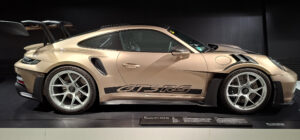
So I walked through the museum slowly. And what struck me wasn’t the speed records or the design evolution or even the engineering, though all of that is genuinely extraordinary. What got me was how uncertain the beginning was.
Before Porsche was Porsche, it was just a man with a conviction that the right car hadn’t been built yet. No guarantee it would work. No roadmap. Just a belief strong enough to act on.
I kept thinking — we’ve been taught to see the finished thing and reverse-engineer a myth of destiny from it. Like it was always going to be Porsche. Like the success was baked in from the start. But that’s not how it works. It never is.
There’s a version of innovation we talk about a lot that sounds like a lightning bolt. A genius has an idea, builds it, and changes the world. Clean, cinematic, satisfying.
The real version is messier. Most things that eventually matter started as someone’s awkward first attempt. Imperfect. Underfunded. Not quite what they’d imagined. And the gap between what they imagined and what they could actually build at that moment — that gap is where most people quit.
Ferry Porsche didn’t quit in the gap. He worked inside it.
That’s actually the skill. Not vision — everyone has vision. The skill is tolerating the distance between the vision and the current reality without flinching. Staying in the work long enough for the work to become the thing.
Walking through that museum, a Gandhi quote kept drifting through my head. Be the change you want to see in the world. We’ve turned that into a bumper sticker. We’ve softened it into something passive — like if you just have good values, you’re participating in change.
But I think it’s meant to be more literal than that. More demanding.
Be the change. Not hope for it. Not advocate for it. Be it. As in, if you think a better car should exist, you build the car. If you think a better system should exist, you build the system. You don’t wait for permission or consensus or the right moment. You start imperfectly, and you let the work become the argument.
That’s what Ferry Porsche did. He didn’t write a manifesto about the car that should exist. He built it.
I study business, and one thing business school teaches you — sometimes subtly, sometimes explicitly — is to mitigate risk. Validate before you build. Research before you commit. Make sure there’s a market. Make sure the timing is right.
And that’s not wrong advice. But it can become an intellectual trap. Because sometimes the thing you’re waiting for — the validation, the signal, the green light — can only come from having built the thing first. There is no data on something that doesn’t exist yet.
Ferry Porsche couldn’t survey customers about a car no one had ever seen. He had to make it real before it could be evaluated.
That’s frightening. It’s also the only way certain things get made.
I’m not saying throw out rigor, research, or planning. I’m saying there is a moment—and you usually know when it arrives—where thinking has done what it can do, and the only remaining question is whether you’re willing to start.
Most people aren’t. Not because they lack ideas, or talent, or even resources. But because starting makes the dream vulnerable. As long as the idea lives in your head, it’s perfect. The moment you touch it, it becomes a real thing with real flaws and real odds against it.
Beginning is an act of courage in that way. Quiet courage, not cinematic courage. The kind that happens in a garage, or a notebook, or a late night with a problem you can’t stop thinking about.
Standing in that museum, surrounded by the physical evidence of one person’s decision to begin, I felt something sharpen in me. Not inspiration exactly—inspiration is cheap and fades fast. Something more like clarity.
The world has enough people who can articulate what should exist. It has fewer people willing to go and make it exist.
The gap between those two groups is not talent. It’s not resources. It’s mostly just the willingness to tolerate uncertainty long enough to build something real.
I almost went to Mercedes-Benz. Vandana wouldn’t let me. And honestly, I think she knew something I didn’t—that sometimes the right person drags you exactly where you need to go.
Ferry Porsche looked around. Didn’t find it. Built it.
That’s available to all of us. Any time we want to start.