


I. Helix Models: Evolution and Limitations in Sustainability
Helix models have evolved to address complex innovation ecosystems. The Triple Helix Model (3HM) emphasizes collaboration among academia, industry, and government to drive economic growth . The Quadruple Helix Model (4HM) expands this by integrating civil society, recognizing the role of public engagement in innovation . Finally, the Quintuple Helix Model (5HM) introduces the natural environment as a fifth stakeholder, acknowledging ecological sustainability as a core driver of innovation .
Despite these advancements, traditional helix models exhibit critical gaps in promoting eco-innovation. While the 5HM nominally includes the environment, its operationalization often lacks depth. For instance, studies highlight that the environment’s role in helix frameworks remains abstract, with limited mechanisms to translate ecological concerns into actionable strategies . Furthermore, interactions between helices are frequently siloed, leading to “circular fallacies” such as problem-shifting or prioritizing economic gains over systemic sustainability .
II. Sustainability and Eco-Innovation: A Critical Gap in Helix Literature
A systematic review of 153 helix model studies reveals a fragmented approach to sustainability. While the 5HM theoretically integrates environmental stewardship, empirical applications often treat sustainability as an ancillary concern.
Key issues include:
1. Unstable Relationships: The connection between helix models and sustainability objectives is inconsistently defined, with few studies operationalizing metrics like the Triple Bottom Line (TBL) or planetary boundaries .
2. Narrow Scope: Most frameworks focus on economic-technological innovation, neglecting socio-ecological systems. For example, eco-industrial parks (meso-level) and regional policies (macro-level) are rarely linked to grassroots community initiatives (micro-level) .
3. Superficial Integration: Sustainability is often reduced to tokenistic goals, such as recycling or energy efficiency, without addressing systemic inequities or resource depletion .
This “shallow” engagement stems from a lack of interdisciplinary theory integration. While institutional theory and entrepreneurship literature inform helix frameworks, they seldom intersect with sustainability science or ecological economics .
III. The Eco-5HM: A Transformative Framework for Systemic Sustainability
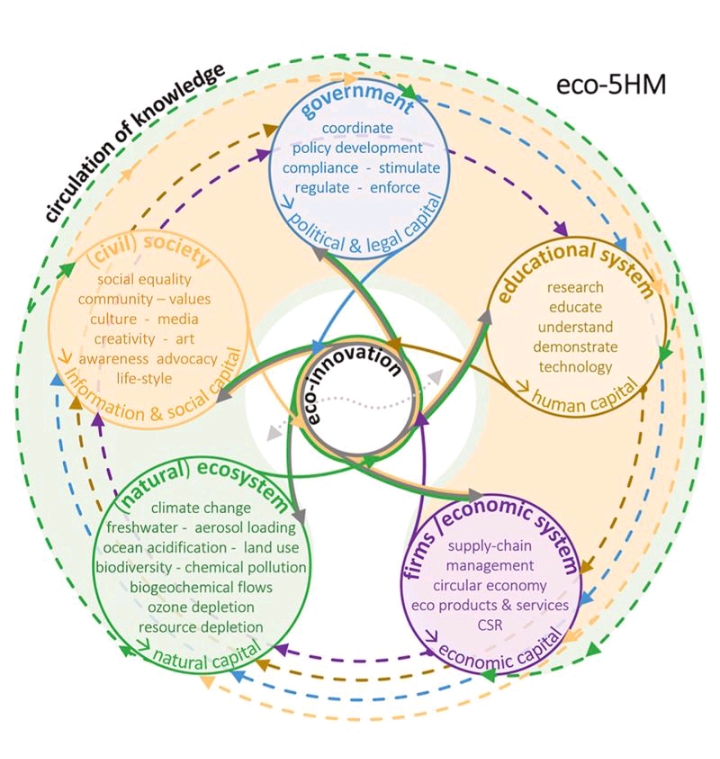
The Eco-Quintuple Helix Model (Eco-5HM) addresses these shortcomings by redefining stakeholder roles and embedding sustainability at every level. Building on the 5HM, it integrates eight key concepts:
1. Hierarchical Triple Bottom Line (TBL): Aligning economic, social, and environmental outcomes across micro-, meso-, and macro-level operations .
2. Nine Planetary Boundaries: Operationalizing ecological thresholds (e.g., climate change, biodiversity loss) as non-negotiable innovation constraints .
3. Stakeholder Synergies: Formalizing 18 strategic relationships among firms, governments, academia, society, and the environment to co-create circular value chains .
Key Innovations of the Eco-5HM:
– Systems Thinking: Unlike traditional models, the Eco-5HM emphasizes feedback loops between stakeholders. For example, universities act as “institutional entrepreneurs,” bridging R&D with community needs .
– Eco-Innovation Indicators: The framework adopts metrics like the Eco-Innovation Index (Eco-IS) to quantify progress in resource efficiency and waste reduction .
– Policy Integration: Governments are tasked with creating regulatory sandboxes that incentivize cross-sector partnerships, such as tax breaks for SMEs adopting circular practices .
Case Study:
Regional Implementation in Huelva, Spain In Huelva, the Eco-5HM facilitated a shift toward circular entrepreneurship. Universities partnered with SMEs to develop bio-based materials, while policymakers introduced subsidies for renewable energy projects. Civil society groups monitored environmental impacts through participatory audits, ensuring accountability .
IV. Implications and Future Directions
The Eco-5HM offers a paradigm shift for eco-innovation ecosystems. By prioritizing collaboration, systems thinking, and education, it enables stakeholders to transcend siloed approaches. Future research should explore:
– Scaling the model to diverse geopolitical contexts.
– Developing AI-driven tools to optimize stakeholder interactions.
– Quantifying long-term impacts on SDG attainment.
The Eco-5HM represents a holistic pathway to align innovation with planetary boundaries. Its strength lies in transforming the environment from a passive stakeholder into an active driver of systemic change.